The annual Farmer’s Workshop has become one of Leopard Ecology & Conservation’s flagship community engagement activities, serving as a vital platform for dialogue, learning, and collaboration. Organising a Farmers’ Workshop provides a vital opportunity to bring together farmers, herders, conservationists, and government stakeholders to address the pressing challenges of living alongside wildlife. In areas surrounding the Khutse Game Reserve, livestock losses due to predation and disease continue to affect rural livelihoods. By creating a structured platform for dialogue, farmers workshops allow communities to openly discuss current human–wildlife conflict trends, share experiences of predator encounters, and explore proven mitigation strategies such as improved kraaling, livestock management practices, and the use of deterrents.
Each year, farmers, herders, and other important stakeholders gather at a centrally located cattle post to reflect on shared challenges and identify practical solutions that balance the needs of people, livestock, and wildlife. By creating a space where local voices are heard alongside expert perspectives, the workshop fosters mutual understanding and promotes long-term coexistence.
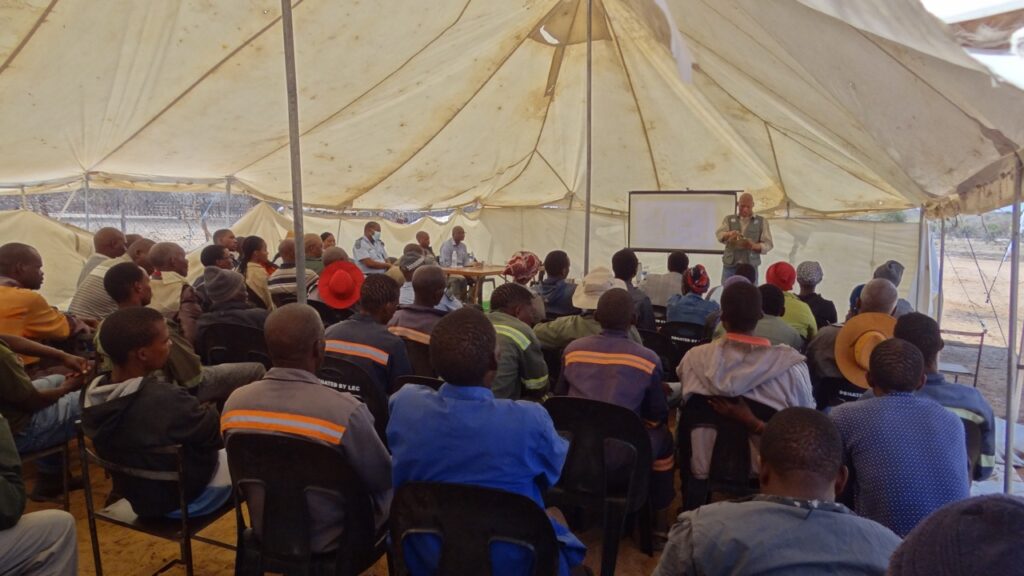
Central to the workshop are the discussions on tried and tested practical traditional knowledge mitigation strategies. Farmers share their own experiences of what has worked or failed in their livestock management practices. These exchanges of knowledge are enriched by the participation of stakeholders. Representatives from the Department of Wildlife and National Parks (DWNP) provide updates on compensation system and conflict management policies, while officers from the Department of Veterinary Services (DVS) share guidance on disease prevention, vaccination schedules, and emerging animal health risks.
In addition, the Department of Animal Production also plays an important role during the workshops by sharing information on government programs and services designed to support livestock farmers. These initiatives include schemes to improve breeding stock, access subsidised feed, and obtain technical advice on animal husbandry practices. By informing farmers of where and how such services can be accessed, the department helps bridge the gap between policy and practice, ensuring that rural communities benefit from the resources available to them.
However, many remote based farmers face challenges such as limited access to information, distance from service centres, or a lack of clarity about application processes. This is where LEC plays a facilitative role by ensuring that information from government departments reaches the farmers in a timely and accessible manner. Equally, LEC ensures that farmers’ concerns, feedback, and enquiries are communicated back to the Department of Animal Production. This two-way exchange creates an effective channel of communication that strengthens the relationship between farmers and government institutions. Ultimately, the farmers’ workshop is more than just meetings, it is a capacity-building forum that improve relationships, mitigate conflict, and promote coexistence in shared landscapes.